Skip to content
Nexus: the modern operating workstation for amateur radio. Brand artwork showing the Nexus mark and wordmark over a night-earth globe traced with great-circle paths.

One program instead of six.

Most stations run a decoder, a logger, a mapper, an alerter and a panadapter app, each with its own settings and its own copy of your log, all fighting over one COM port. Nexus does that work in one place, with one log, across one or multiple radios. Free and open source, built in Rust by KD9TAW.

You need a radio, a USB cable and a computer — Windows, Linux or Raspberry Pi. No radio yet? The APRS map, the DX cluster and the propagation globe run on internet feeds alone.

ver
0.21.5
platforms
Windows · Linux · Raspberry Pi
license
GPL-3.0
source
open

What it is

The whole stack, in one place

Each of these jobs is usually its own download. In Nexus they share one radio, one CAT layer and one log.

The jobIn Nexus
Work the modesFifteen modes, transmit and receive — FT8, FT4, CW, SSB and FM, RTTY, SSTV, APRS, meteor scatter and more, each on its own calling frequency.
See who is on, and from whereBand activity with country, distance and bearing on every decode, a call roster ranked by what each station is worth to your log, and a 3-D globe with live spots.
Hear about the ones you needAlerts scored against your own log — new country, new state, new park, new grid — by tone, banner and desktop notification.
Log it and count itOne logbook. DXCC, WAS, WAZ, per-band VUCC and IOTA computed offline from your own log, with no account required.
See the actual spectrumOn native-CI-V Icom and network Flex radios, the rig's own RF panadapter; a live audio scope on everything else.
Know why it is quietWhen nothing decodes, the readout names the cause — wrong frequency, wrong input, closed squelch — with a Tune button beside the fix.
Program the radioRepeater search, curated memory packs, and CHIRP CSV round-trip reaching roughly 1,000 radio models.
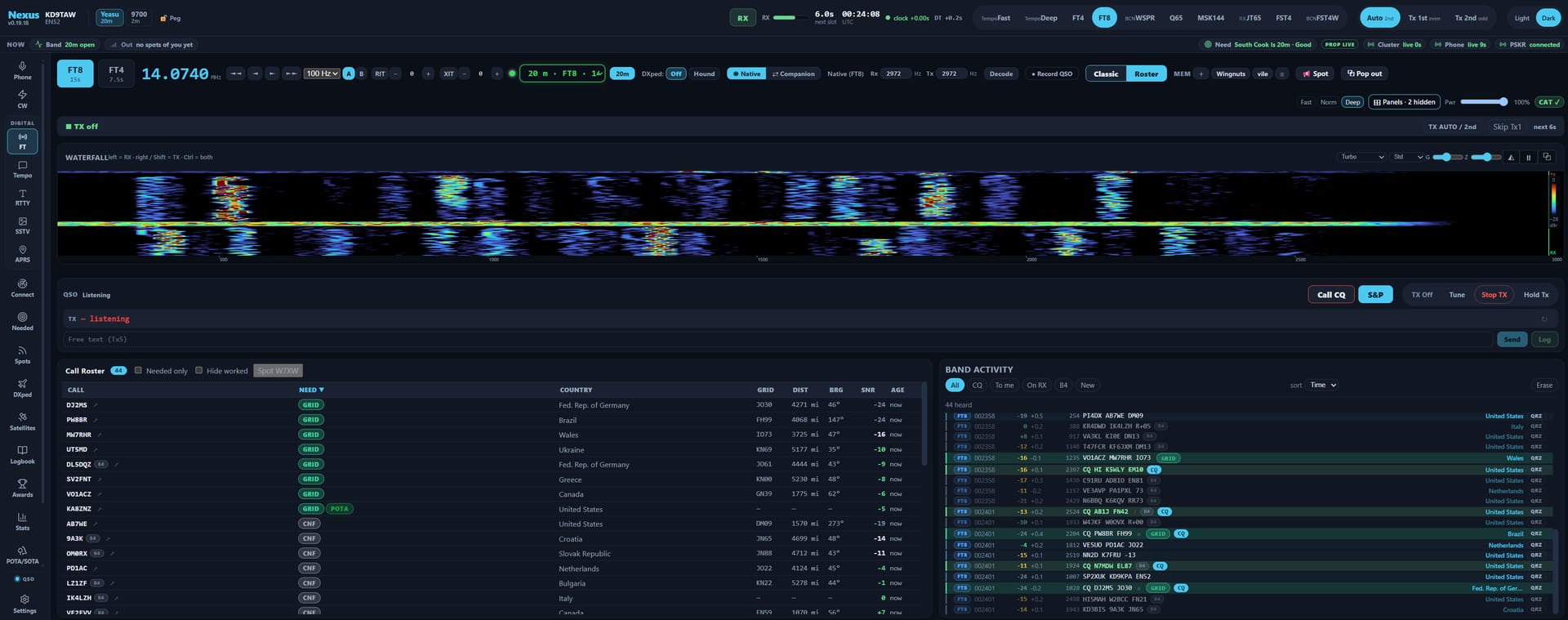
The Nexus FT8 and FT4 cockpit: waterfall, sortable call roster and live band activity

FT8 / FT4 cockpit

The operating core. A waterfall you can pause and scroll back through, a call roster ranked by what each station is worth to your log, and band activity carrying country, signal report, distance and bearing on every decode.

New to digital?

Start here

Setup is three skippable steps: Nexus reads the USB descriptors, matches your radio, and pairs the sound device — then offers to import an existing log or starts a fresh one. Technician privileges reach a long way here: satellites with rotor tracking, APRS, FM repeaters, meteor scatter and the memory packs are all first-class. And when a contact does not happen, the readout names the cause.

If you already run WSJT-X

The FT8 and FT4 sequencer is built to WSJT-X's behaviour, the keyboard shortcuts are the same, and the UDP protocol is byte-for-byte identical, so GridTracker, JTAlert and your logger keep working exactly as they do now. Companion mode goes further: Nexus rides a WSJT-X, JTDX or MSHV decode stream while the other program keeps the rig. Your log arrives by ADIF import, leaves by ADIF export, and is backed up on disk before every load. Nothing you already run has to change.

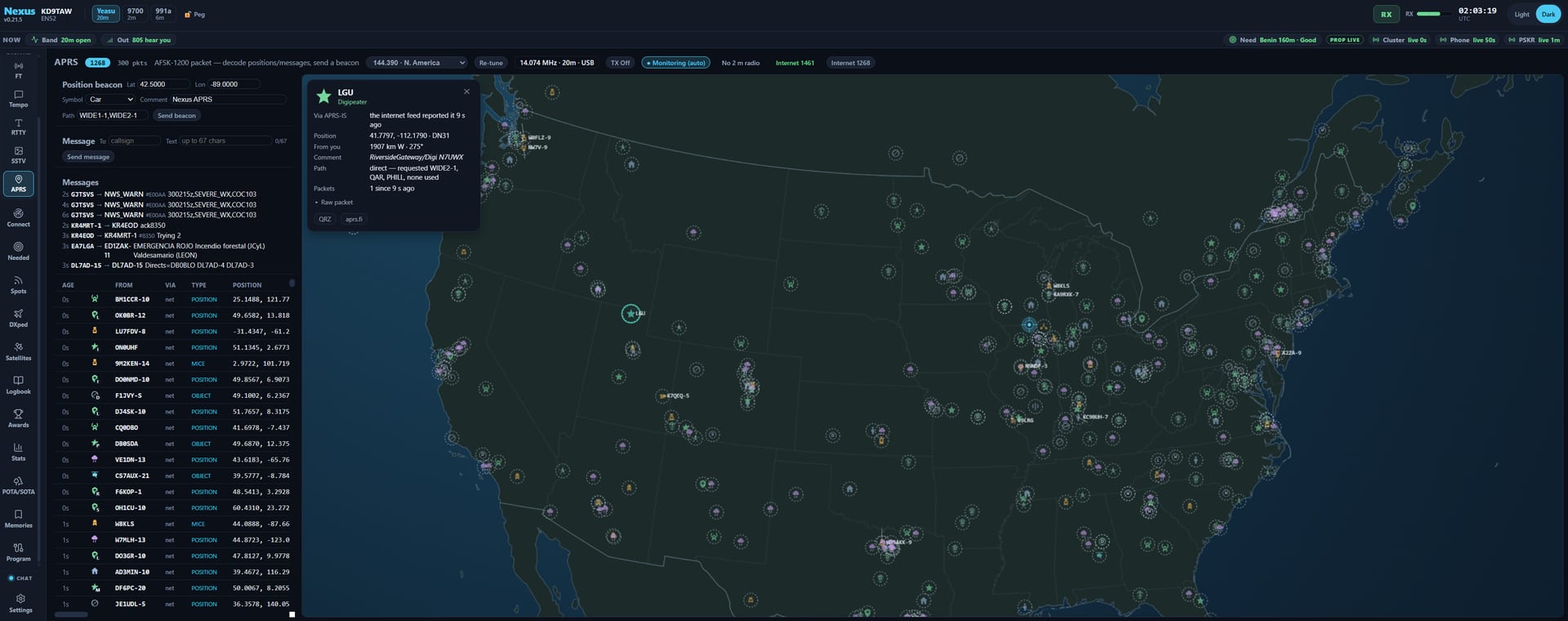
Nexus APRS: a station map drawn with real APRS symbols, an open station detail card, and the decode readout

APRS

APRS with real station symbols and a detail card carrying distance, bearing and digipeater path. When no 2 m radio is attached, the readout says so.

The case for it

What the usual stack doesn't do

Two capabilities you cannot assemble from separate programs, however many you run.

01

Nobody can tell whether a band is open for them

Cluster and skimmer feeds are global. A superstation on a mountain hearing a rare one tells you almost nothing about what your antenna can reach from your yard, and prediction tools model monthly medians for a station that is not yours.

What Nexus does

Openings are scored on receivers near you
On VHF a single genuine path past 700 km opens a band, because a tropo or aurora opening is often one distant station rather than a crowd.
Every Needed row shows its evidence
"Heard by K9LC (EN52, 26 km), 4 min ago." You know the path is real before you call, before the pileup forms.
A real link budget, built in
The same class of prediction engine as VOACAP, running natively in the app with nothing extra to install. Every prediction is labelled modelled.

Honest limit This measures the paths other stations report. It does not yet map your own antenna pattern or calibrate against a beacon ladder, so it can tell you a path is open and still not know that your null is pointing at it.
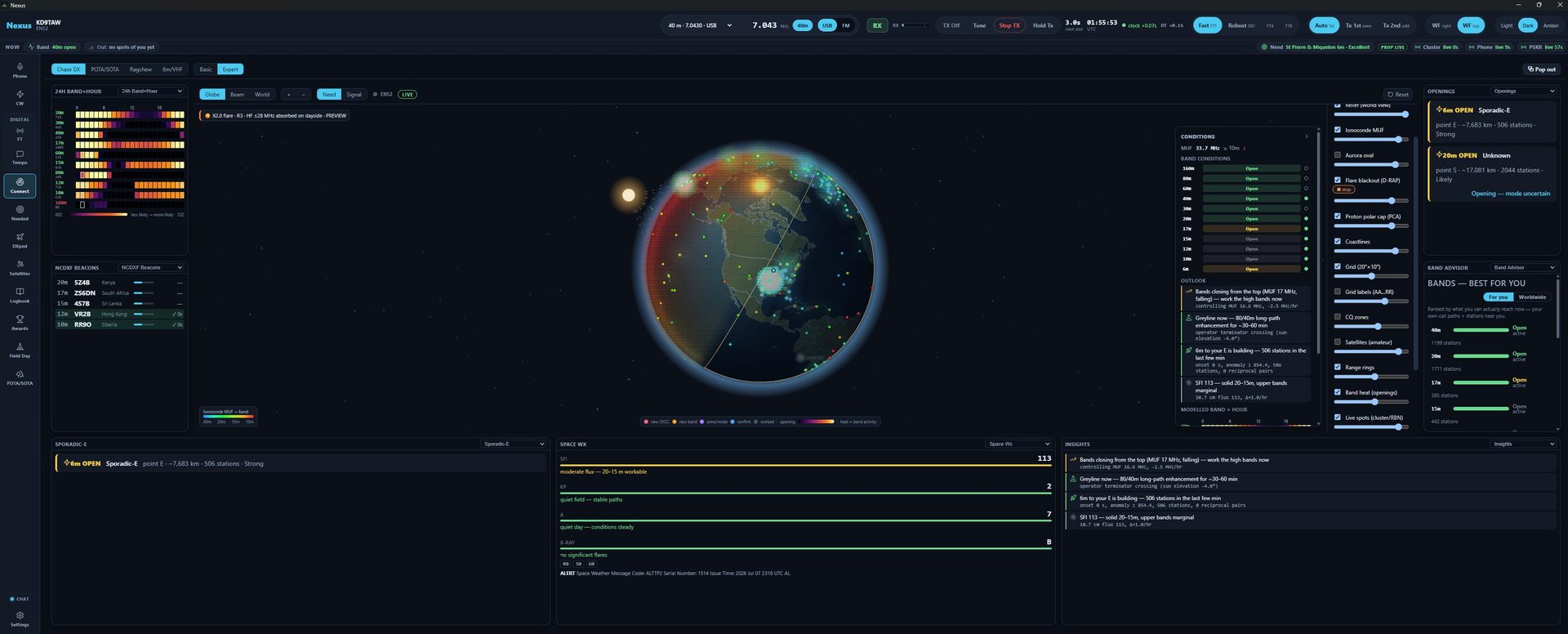
Nexus Connect: a shaded 3-D globe with greyline, live spots and propagation layers

Propagation

Greyline, live spots, aurora, the solar-flare layer and measured MUF on a shaded globe, in an assignable pane grid. Predictions come from the built-in engine and are labelled modelled wherever they appear.

02

Eyes and ears change; the station keeps working

Plenty of operators lose some hearing or some sight along the way, and it pushes people off SSB, off CW, off waterfall-first screens. Nexus treats a screen reader, a keyboard and an ear as equal ways to run the station — with nothing to switch on, and nothing changed for anyone else.

What Nexus does

Screen readers work out of the box
JAWS and NVDA hear the QSO sequencer advance, and transmit and receive switches are announced assertively. There is no separate accessibility mode.
The boards are keyboard-navigable
Arrow through band activity, the Call Roster and the Needed list, and each row is read aloud. Enter selects, Shift+Enter works the station, Alt+Enter ignores it.
You can operate by ear
Optional spoken decode announcements, a transmit and receive earcon, and a soft per-cycle decode tick. All of them default to quiet.
You can work CW by eye
The CW cockpit's decode transcript is the dominant pane, driven by a neural-net decoder, with transmit and receive state shown on screen. Hearing trouble does not take the key away.
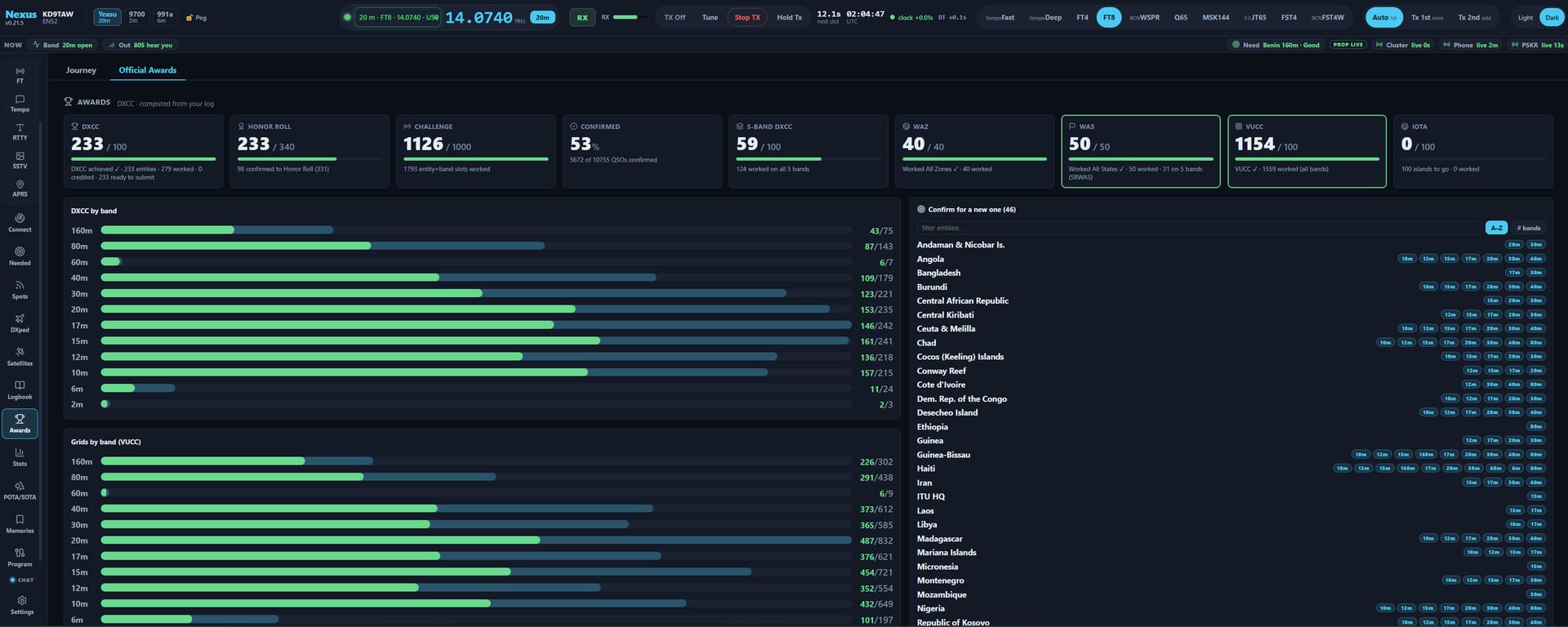
Nexus awards: DXCC, Challenge, WAS, WAZ, VUCC and IOTA computed from your log

Awards, offline

DXCC, Challenge, Honor Roll, WAS, WAZ, per-band VUCC and IOTA, computed from your own log with no account and no upload required. Each confirmation keeps its source: an eQSL or QRZ match shows as confirmed but never counts toward DXCC or WAS, because those awards do not accept it. The totals survive a real award application.

Station integrity

Your radio, your log, your call

The rules Nexus holds itself to, in every mode and every keying path.

RuleWhat it means
Opens read-onlyConnecting to the radio commands nothing until you act. A rig parked on 40 m LSB for a net stays there.
Never keys unattendedTransmit sits behind an explicit arm with a watchdog that covers beacons, and internet traffic is never gated back onto the air.
Licence-awareYour licence class is a hard lockout in every keying path, Part 97 sub-bands included, with per-mode power ceilings.
Your log stays yoursADIF in and out, the raw logbook backed up before every load, and awards computed offline with no account.
Private by defaultCredentials live in the OS keychain. Crash reports carry addresses and module names only — no callsign, no log data.

Works with your shack

Nothing you already run has to stop working

Nexus speaks the protocols the ecosystem runs on, so the switch can be gradual: run it alongside what you have, and it feeds your logger and your alerter the whole time.

IntegrationWhat it does
WSJT-X UDPByte-for-byte. JTAlert and GridTracker see a WSJT-X.
CAT brokerA rigctld-compatible port so other software shares the radio through Nexus.
Companion modeRide an upstream WSJT-X, JTDX or MSHV decode stream instead of owning the rig.
LoTWTQSL upload and incremental confirmation sync.
QRZ.comCallbook autofill, two-way logbook sync, optional hourly confirmation pulls.
ClubLog · eQSL · HRDLogReal-time push and InBox confirmation import.
N1MM+ · N3FJPContest and everyday contact push. Broadcast every QSO, event or not.
DXKeeper · CloudlogPer-contact push to DXLab and self-hosted Wavelog instances.
APRS-ISRead-only network feed, plus an optional receive-only iGate.
DX cluster · RBNTelnet feed with locality-gated VHF admission.
PSK ReporterPropagation data in, standard spot uploads out.
CHIRPFull CSV round-trip, so channels flow to roughly 1,000 radio models.

Status

Where each piece stands

Production

The FT8 and FT4 core is the production tier, and it is measured against the reference rather than against itself.

Over a thousand automated tests, wire formats pinned by test, and a decode floor measured against stock WSJT-X on identical recorded audio — the numbers are on the features page. Field-verified end to end on Yaesu FTDX10 and FT-991A and on native-CI-V Icom, where the IC-9700's own panadapter streams live.

On the air

APRS receives and maps, with the internet feed and the receive-only iGate confirmed against a live connection.

Transmit sits behind an explicit arm. Opening the APRS screen only ever starts a receive-only decoder, and internet traffic never gates back out onto the air, because that would mean a radio keying up unattended.

Still beta

The FlexRadio native panadapter is opt-in and not yet confirmed on hardware here, and the Tempo sensitivity figures are still bench numbers.

TempoFast and TempoDeep have closed real links on the air, including a completed two-station QSO on 6 m; on-air reports are what turn the bench numbers into field ones. There are no contest modes beyond Field Day.

Unsigned installer

The Windows installer carries no code-signing certificate yet, so SmartScreen shows an unknown-publisher warning on first install.

Choose More info, then Run anyway. The SHA-256 of every artifact is published beside the download if you want to verify by hand, and the app's own updates are a separate path — each one is cryptographically verified before it installs.

Licence

Free software under the GNU GPL v3, and not affiliated with the WSJT project, the ARRL, or any radio manufacturer.

The digital modem is derived from WSJT-X and reuses their GPL-licensed code. Nexus is built on the community's work, and the full lineage — qracodes, fldigi, slowrx, Hamlib and the DeepCW model — is recorded in the repository's NOTICE file.

The complete list of what Nexus does not do — no contest modes beyond Field Day, no Fox role, no outbound iGating, no digital-voice programming — is on the features page.

Get it, get help

Most of what shipped this year started as somebody's bug report

Operator

Written by the operator who uses it

KD9TAW. Licensed in 2021; DXpeditioner to KP2 and VP2V, first in Illinois in CQWW 160 m DX 2025, and designer of the TempoFast and TempoDeep waveforms. Nexus is built by an operator recent enough to remember being new, and it is the software on the air at the station it came from.